The Multiplier Math
A great hire raises the ceiling 5-15%. A bad hire lowers the floor 30-40%. Both effects compound quarter over quarter. Team composition is the rank-1 leverage decision a leader makes - and most leaders spend most of their time on rank 4.
A team that was shipping cleanly six months ago is now struggling to close standup without tension. The senior engineers have gone quiet. The designer has stopped offering opinions in review. Retros are shorter because nobody wants to name what changed. When the leader traces the timeline back, it lands on a single hire - a strong individual contributor on paper, a net-negative presence in practice.
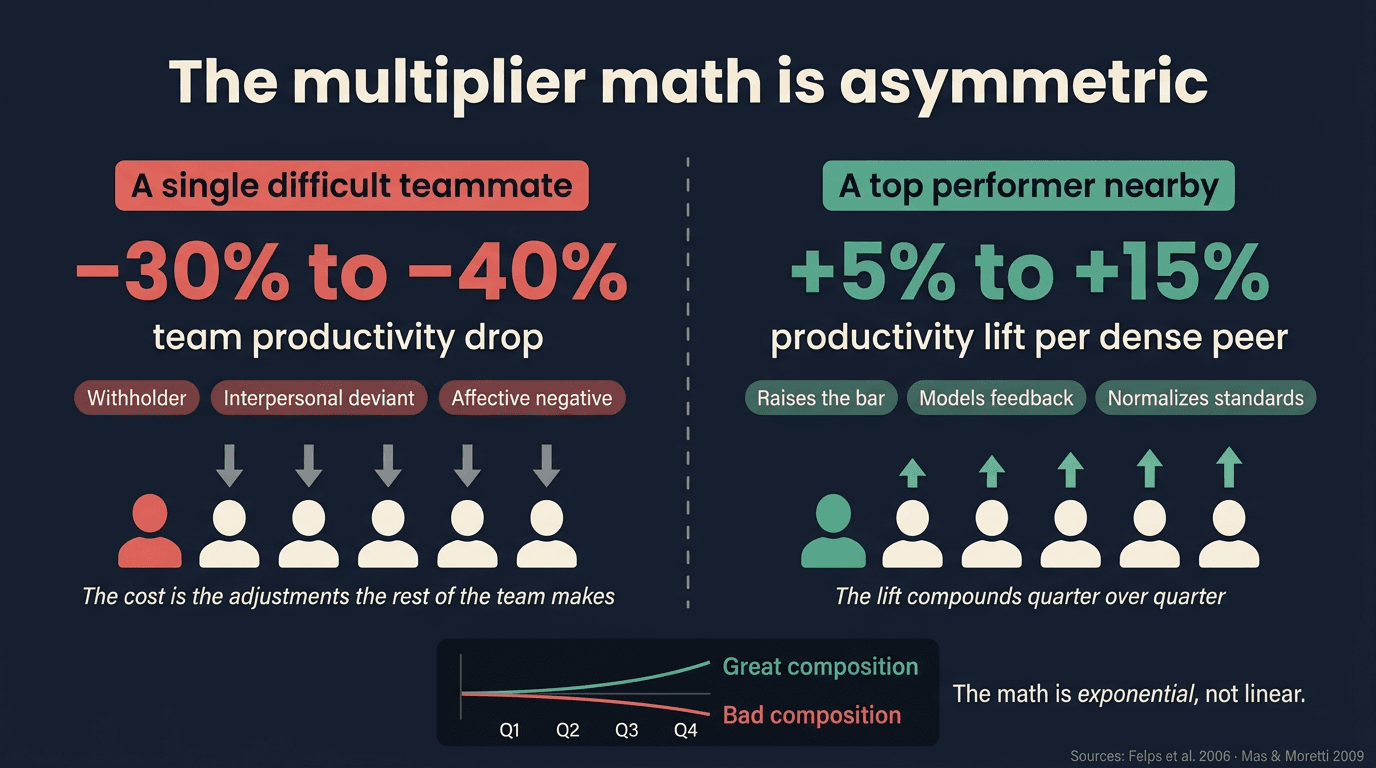
The leader will replay the interviews. They will blame the rubric. They will promise a better loop next time. What they will rarely do is name the mathematical shape of what happened, because most leadership training does not teach it. A great hire raises the team's ceiling by roughly 5 to 15 percent. A bad hire lowers everyone's floor by 30 to 40 percent. The math is not symmetric. The math also does not stay put - it compounds across quarters.
We call this the multiplier math, and it is the single highest-leverage decision a leader makes every week. Architecture decisions are reversible in months. Tooling decisions are reversible in weeks. Composition decisions are reversible only through a hire, an exit, or a role change, and the cost is measured in quarters.
The multiplier math
This post is the math, the research behind each component, and the operational practice. It is the foundation for the rest of the Building Teams That Build Systems series: the hiring loop, the lead/coach/manage-out doctrine, the coaching practice, the development engine, and the exit conversation all run on it.
The bad apple math is not symmetric
The foundational study is Felps, Mitchell, and Byington's 2006 review in Research in Organizational Behavior, How, When, and Why Bad Apples Spoil the Barrel. They document three behavior patterns that consistently drag group performance down by more than a third: the withholder who under-contributes, the interpersonal deviant who belittles or interrupts, and the affective negative whose pessimism spreads across the room. The headline number - a 30 to 40 percent drop in group productivity when any one of these patterns is present - is not an anecdote. It reproduces across lab, field, and longitudinal studies.
The mechanism is worth understanding because it tells you where to intervene. The rest of the team adjusts to the worst behavior to avoid conflict. Top performers pick up the slack quietly. Designers and product managers route around the difficult engineer. Retros get safer and shorter. Decisions get made in side channels. Nobody calls the problem by name, because the social cost of naming it is higher than the productivity cost of absorbing it. The math is not driven by the bad apple's own output. It is driven by the dozen adjustments everyone else makes every day.
One framing hazard here: we are careful not to call a person a bad apple. The research is about behavior patterns, not about labels. We hold the same doctrine we published in It's the Process, Not the Person. When one of these patterns shows up, the first question is what about our system hired, rewarded, or tolerated it. Only after that is answered honestly does the conversation about the individual become coachable instead of accusatory. The bad-apple corollary we noted there is the shape of this post: the blameless leader is not soft on the behavior; they remove it before the asymmetry compounds, and they do it as a composition decision, not a verdict.
All-star math runs in both directions
The positive side of the asymmetry is smaller per head but real. Mas and Moretti's 2009 study Peers at Work in the American Economic Review provides the cleanest causal evidence we have: in a natural-experiment setting where cashiers were randomly exposed to different peers, each highly productive peer nearby lifted an individual's productivity by about 1.7 percent. Stack three or four of those peers around someone - which is what a densely staffed team does - and the aggregate lift lands in the 5 to 15 percent range. Edward Lazear's earlier piece-rate work at Safelite Glass (The Power of Incentives, American Economic Review, 2000) and his later Personnel Economics survey with Shaw (Journal of Economic Perspectives, 2007) give the microeconomic theory that matches the empirical pattern.
The mechanism is about norms, not effort. Top performers normalize high standards. They raise the threshold of what feels acceptable in a design review. They model how to give and receive feedback. Daniel Coyle's The Culture Code (2018) documents the same effect under a different name: small belonging cues from high-status members - a quick acknowledgement, eye contact, a specific question - compound across the team. The team begins to imitate the grammar of its best members within a quarter.
The reverse case is the one senior leaders most often get wrong: the brilliant jerk. A high-output individual who belittles peers, hoards context, or treats feedback as insubordination is delivering their own output while suppressing five to ten others. The net sign on the team is negative even when the individual's output is a standout. This is where the asymmetric math becomes a hiring decision that looks counterintuitive on paper and is obvious in the standup two quarters later.
Multipliers compound quarter over quarter
A great hire compounds in three ways. First, they raise the bar for the next hire, because the team becomes a more attractive place for top talent and the interview loop naturally holds a higher floor when the people interviewing are themselves high signal. Second, they develop the team around them: the standards they model spread, and the growth rate of mid-career peers measurably increases when a clear role model is a few desks away. Third, they reduce the invisible tax on your other top performers, who now have peers to argue with instead of a room full of people they are pulling along. Each of these effects is small per quarter and enormous across a year.
The reverse compound is what makes this strategic rather than incidental. A bad composition decision lowers the bar for the next one (the team looks less competitive from the outside, and the interview loop learns to accept less). It drains existing top performers, who pay the adjustment tax from Section 1 every day. It reduces the team's talent density, which - Reed Hastings and Erin Meyer argue through the Netflix playbook in No Rules Rules (2020) - is the single factor most responsible for a team's ability to operate with high context and low process. Once talent density slips, process has to be added to compensate, and the team begins to feel slower for reasons nobody can quite name.
The math is exponential, not linear. Two great composition decisions in the first year of a team do not add 20 percent; they set a trajectory that separates the team from its peers over three years. This is why founders who get composition right in the first ten hires are still winning on talent quality five years later, and why the founders who did not are still trying to claw back the baseline. The structural argument for cross-functional teams we made earlier sits downstream of this: structure shapes coordination, composition shapes capacity, and capacity is the harder constraint.
Composition is the rank-1 leverage a leader has
Andy Grove's High Output Management (1983) has the frame we still use for ranking a leader's daily decisions by leverage. We rank them like this:
Rank 1 - Composition: who is on the team.
Rank 2 - Systems: the processes, tools, and doctrine they operate in.
Rank 3 - Outcomes: the objectives and key results they pursue.
Rank 4 - Tactics: the architecture, sprints, and day-to-day execution.
Most leaders spend most of their time on rank 4, because rank 4 produces legible artifacts and fast feedback. Composition decisions are quiet, emotionally expensive, and feel slow. They are also the decisions that determine whether rank 2 through 4 produce leverage or noise. A brilliant tactical plan executed by the wrong composition produces a team that is busy and behind. A serviceable tactical plan executed by the right composition produces a team that compounds past its peers.
The practice we try to hold ourselves to is simple and uncomfortable. Every week, name one composition decision and treat it as the highest-priority decision of the week. It might be a hire, an internal move, a scope change, an explicit coaching plan, or a hard conversation about fit. Some weeks it is small. Some weeks there is nothing new and the decision is to reinvest in the current composition deliberately. The point is that composition never falls off the top of the leader's agenda, because the math says it is always the highest-leverage item on the list.
Reframe the hiring bar as a multiplier bar
Grove's operational test for whether a person belongs on the team is one question: would I rehire this person tomorrow? It is the sharpest tool we know for cutting through the fog of tenure, politics, and familiarity. We extend it for the hiring side using the multiplier math directly. When we close out an interview loop, the two questions that decide yes or no are:
The average question: will the team's average rise if this person joins, across technical skill, judgment, and the behaviors we want to spread?
The next-hire question: will this person raise the bar that the next hire has to clear, because their presence makes the team more selective and more attractive?
Two yeses is a hire. Anything else is a pass. The signals we use to answer those questions are as structured as we can make them, because Schmidt and Hunter's 1998 meta-analysis in Psychological Bulletin (The Validity and Utility of Selection Methods in Personnel Psychology) is still the best available evidence that structured interviews and work-sample tests are the two highest-validity hiring signals a team can use. Laszlo Bock's Work Rules! (2015) is the most accessible popular translation of that finding and of the cost-of-bad-hire math that follows from it.
That cost is where leaders most often miscalculate. The cost of a bad hire is not the salary. It is the adjustment tax from Section 1 across every peer for every week of their tenure, plus the exit itself, plus the rebuild, plus the opportunity cost of the person you did not hire in their slot. The cost of being short-staffed for an extra month to hold the bar is bounded and visible. The cost of a bad hire is unbounded and largely invisible until the damage is done. Slow hiring is not a failure of urgency. It is a discipline that respects the asymmetric math.
The structural guardrail we use on top of the two questions is a no rule on our hiring loops: any single interviewer on a panel can veto a hire, and a veto stands unless every other interviewer agrees to revisit it and a specific concern is resolved. Most teams run an implicit yes rule, where consensus-to-hire is the bar and a single skeptic gets rolled. The yes rule raises throughput at the cost of the floor. The no rule holds the floor at the cost of throughput. Given the asymmetric math, we would rather miss a candidate than admit one the panel was not certain about. This is the same logic that sits under the Netflix Keeper Test and under how we think about hiring AI agents into a team - the parallel we made in Hire the Robots.
Name the exit threshold before you need it
The reverse of the hiring bar is the exit threshold, and the math works the same way. When someone on the team is a net negative - not merely underperforming but actively imposing the Section 1 tax on their peers - every week you wait is a week of compounded cost that is paid by everyone else. The common failure is for a leader to feel the decline, name the pattern privately, and still defer the hard conversation, because the conversation is uncomfortable and the person has history.
The signals are legible if you know where to look. Top performers go quiet in the difficult teammate's presence. Retros lose energy on exactly the topics where the pattern shows up. Design reviews degrade from substantive disagreement into polite nods. Attrition begins - not from the person causing the pattern, but from the ones tired of working around them. Reed Hastings and Erin Meyer's Keeper Test from No Rules Rules (2020) is the sharpest version of the exit reframe: for each person on the team, a manager asks whether they would fight to keep them if they told the manager they were leaving tomorrow. A no is a signal, not a verdict, but it is a signal the manager is obligated to act on.
The discipline we try to hold, and the one we will spend two later posts on, is naming the exit threshold in advance. The criteria - culture fit, cross-discipline peer feedback, same-discipline peer feedback, and an honest assessment of company stage and runway - should be written down before they are needed, so that when the moment comes the decision is made on principles rather than on the emotional weather of the day. The doctrine behind that decision - whether to lead, coach, or manage out - is a later post in this series, and the operational mechanics of the exit conversation itself come later still. What belongs here, in the math post, is the reason the threshold has to exist: every week you hold a pattern that is compounding against the team, the team is paying interest on a decision you have already made privately and have not yet acted on.
How to start tomorrow
The math is too big to "adopt." It is small enough to start practicing in the next week. Pick one of the following and use it. The others will follow naturally once the first one is a habit.
Audit the team against the three multiplier components
Name the one composition decision this week
Write your hiring bar into the hiring loop
Read the underlying research
Why this is the spine of the series
Composition is rank-1 leverage. The math is asymmetric. The effects compound across quarters. Those three facts, held together, are the reason the teams we admire feel different within a month of meeting them - and why the teams that quietly stall feel that way for reasons their leaders can never quite pin on any one person. Teams that practice the multiplier math are teams that treat composition as a weekly decision, not a quarterly one, and that treat it as a principled one, not an emotional one.
The rest of Building Teams That Build Systems is the operational practice the math demands. The next post is the hiring loop and the multiplier interview. After that is the lead, coach, or manage out doctrine that tells you which of the three moves a struggling team member's situation calls for. After that is coaching across functions, the development engine of objectives and peer review and structured feedback, and finally the hard half of building a team: the exit conversation run with respect. Every one of those posts is downstream of the math in this one.
Run the math on your team
If you are building a team where composition decisions are the weekly priority, where hiring loops hold the multiplier bar, and where AI agents are treated as first-class members of the composition, we should talk.