The TCP/IP Moment
MCP gives agents hands. Chat protocols give them voices. Payment protocols give them wallets. Together they form a protocol stack that will define the next decade of software - and the teams that adopt early will have a compounding advantage.
In 1983, ARPANET adopted TCP/IP as its standard protocol. At the time, it was a technical decision made by a small group of engineers. Within a decade, it created the internet. Within two decades, it created a $50 trillion global digital economy.
Nobody at the time said "this protocol decision will reshape civilization." They said "we need a standard way for computers to talk to each other."
We are at that moment again - but for AI agents instead of computers.
In the last four months, three things happened that will look inevitable in hindsight: Anthropic donated the Model Context Protocol (MCP) to the Linux Foundation. Google released version 0.3 of the Agent-to-Agent (A2A) protocol. And the Agentic AI Foundation (AAIF) launched under the Linux Foundation with Amazon Web Services, Anthropic, Block, Bloomberg, Cloudflare, Google, Microsoft, and OpenAI as founding platinum members.
Meanwhile, Fetch.ai shipped production agent communication and payment protocols in the uAgents framework - and built a bridge mapping that translates between its Payment Protocol and Google's AP2 (Agent Payments Protocol). These are not competing products. They are complementary layers of a protocol stack - and understanding the difference between a tool protocol and an agent protocol is the most important technical decision your team will make this year.
Why Protocols Matter More Than Products
Products are built on protocols. The protocol winners create entire economies that last for decades. The protocol losers are forgotten - along with everything built on them.
Protocol Winners Create Economies
Created the web economy. Every website, web application, and software-as-a-service business runs on it. Amazon, Google, and Netflix are HTTP companies.
Created email marketing, enterprise communication, and the $10 billion+ email economy. Every newsletter, transactional email, and marketing campaign uses it.
The payment card message format. Every credit card swipe, every ATM withdrawal, every Stripe charge ultimately speaks this protocol. Visa and Mastercard are ISO 8583 companies.
The pattern is consistent: a protocol standardizes how entities communicate, and an ecosystem of products, services, and entire industries grows on top. The protocol itself is often free and open - the value accrues to whoever builds the best products on the standard.
The Pattern
The Protocol Landscape
The most common misunderstanding in the current discourse is treating these protocols as competitors, or as layers in a stack where each builds on the one below. They are neither. They are orthogonal capabilities - and understanding that distinction is the key to making the right investments.
Two Axes, Not One Stack
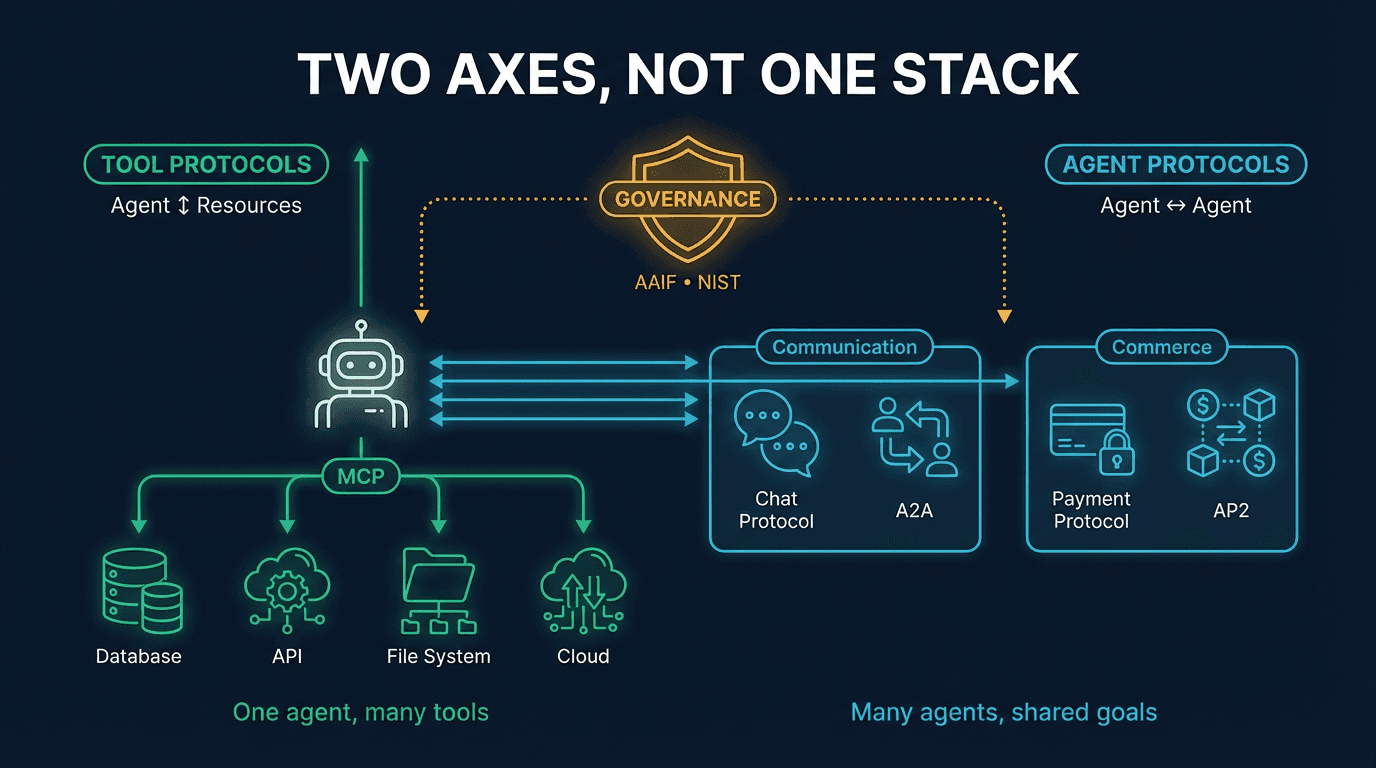
Agent connects downward to passive resources. The tool does not initiate - it responds.
- Query a database
- Call an external API
- Read and write files
- Access cloud services
One agent, many tools.
Agent connects sideways to other agents as autonomous peers. Both sides act.
- Discover and authenticate peers
- Exchange structured messages
- Negotiate and delegate tasks
- Request, commit, and settle payments
Many agents, shared goals, real transactions.
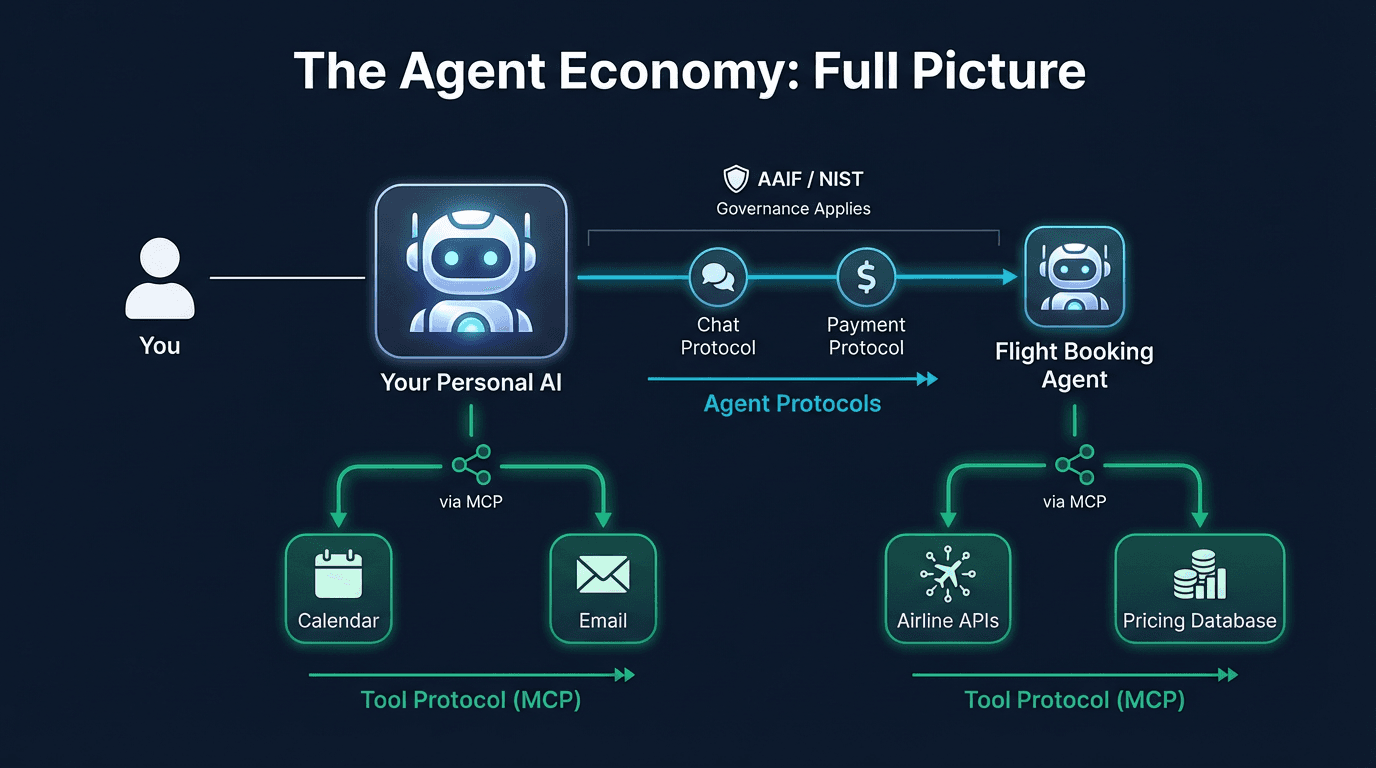
A single agent using MCP to access Slack, GitHub, and a database is powerful. But a team of agents - your personal AI coordinating with a flight booking agent via Chat Protocol, settling payment via Payment Protocol, while the flight agent independently uses MCP to query airline APIs - that is the full picture. The tool protocol gives individual agents capability. The agent protocols give them an economy.
Tool Protocol: Model Context Protocol (MCP)
Created by Anthropic in November 2024, donated to the Linux Foundation in December 2025. MCP standardizes how an AI model or agent connects to external tools, databases, APIs, and services. It is the standardized interface between a model and the external world - but it is not a foundation that agent protocols build upon. Agents use MCP the same way a person uses a phone: it extends their reach, but it does not define their relationships.
By February 2026, MCP reached 97 million monthly SDK downloads. ChatGPT, Claude, Visual Studio Code, and Goose support it natively. Google announced official MCP support for Cloud services including BigQuery, Compute Engine, and Kubernetes Engine.
Agent Protocols: Communication and Commerce
Agent protocols operate on a separate axis from MCP. Where MCP connects an agent to resources, agent protocols connect agents to each other. Within this axis, there is a natural progression: agents must be able to communicate before they can transact.
Communication
Agents discover, message, and collaborateFetch.ai Agent Chat Protocol (v0.3.0)
Part of the Fetch.ai uAgents framework. Defines structured message types for agent-to-agent conversation: text content, resource sharing, session management, and streaming. Agents exchange ChatMessage objects with typed content arrays and receive ChatAcknowledgement confirmations. Protocols are registered in the Almanac Contract for ecosystem-wide discovery.
Google Agent-to-Agent Protocol (A2A) (v0.3)
Enables AI agents to discover each other, negotiate capabilities, authenticate, and collaborate as peers - regardless of which framework or vendor built them. A2A introduces Agent Cards: machine-readable capability descriptors that let agents find and evaluate potential collaborators. Over 150 organizations have adopted it, including real-world deployments at Tyson Foods and Gordon Food Service.
Commerce
Agents negotiate, pay, and settleFetch.ai Agent Payment Protocol (v0.1.0)
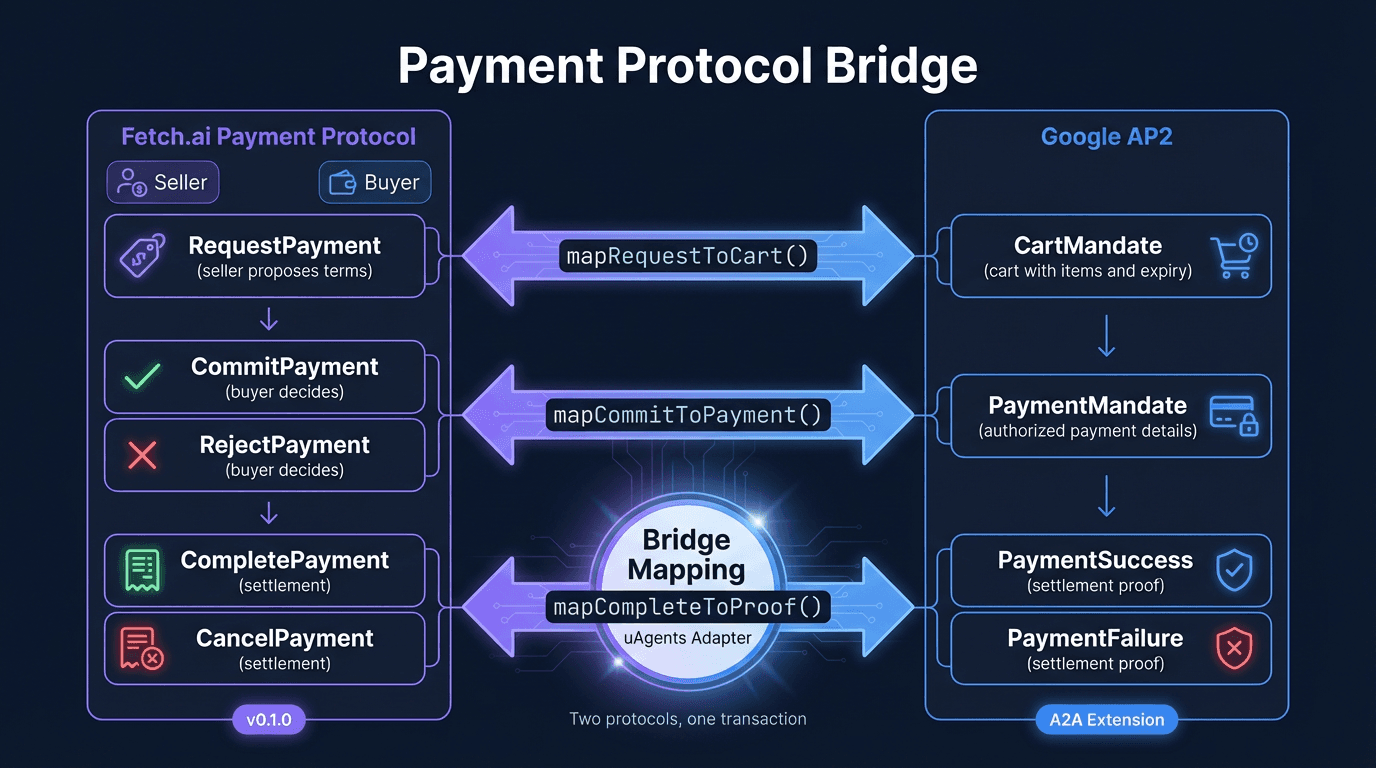
Standardizes payment negotiation between buyer and seller agents. The protocol defines a clear state machine: RequestPayment (seller proposes terms) → CommitPayment or RejectPayment (buyer decides) → CompletePayment or CancelPayment. Supports multiple currencies (USDC, FET) and payment methods including on-chain verification.
Google Agent Payments Protocol (AP2)
A companion to A2A that formalizes three schemas: Agent Identity (with decentralized identifiers and policy claims), Payment Intent (with policy traces and line items), and Settlement Proof (capturing immutable payment outcomes). AP2 also includes an A2A x402 extension that revives HTTP 402 "Payment Required" for decentralized agent commerce.
The bridge already exists. The Fetch.ai uAgents adapter includes bidirectional mapping between both payment protocols - CartMandate converts to RequestPayment, PaymentMandate converts to CommitPayment, and vice versa. Two payment protocols, one transaction. This is interoperability in production, not theory.
Governance: Trust Infrastructure
Governance sits above both axes - it does not depend on any specific protocol, but it provides the trust and standards that make all of them viable at scale.
Agentic AI Foundation (AAIF)
Launched December 2025 under the Linux Foundation with Amazon Web Services, Anthropic, Block, Bloomberg, Cloudflare, Google, Microsoft, and OpenAI as founding platinum members. Now at 146 member organizations. AAIF provides neutral governance for MCP and the broader agent ecosystem, preventing the fragmentation that killed earlier standardization attempts.
NIST AI Agent Standards Initiative
Launched February 2026 - the first United States government framework specifically targeting autonomous AI agents. Focuses on agent authentication, identity infrastructure, and security evaluation. Distinct from earlier AI governance efforts that targeted models rather than agent actions.
AAIF and NIST are like the Internet Engineering Task Force (IETF) and the Internet Society - the governance bodies that turn protocols into trusted infrastructure.
What This Means for Teams Building with AI
If you are building products that involve AI agents - which increasingly means every product - the protocol decisions you make now will compound for years. Here is what the landscape means in practice.
Adopt MCP for Tool Integration (Now)
MCP is the standard for connecting agents to external services. With 97 million monthly SDK downloads and native support from every major AI provider, this is no longer a bet - it's table stakes. If your product exposes an API that agents should use, ship an MCP server. If your agents use external tools, connect via MCP.
Implement Agent Communication Protocols (Next)
If your agents will collaborate with agents from other teams, vendors, or organizations, adopt agent communication protocols now. Fetch.ai's Chat Protocol and Google's A2A both define structured messaging between autonomous peers. Publish Agent Cards (capability descriptors), register in discovery networks, and separate internal logic from the collaboration interface.
Build Payment Into the Agent Layer (Next)
Agent commerce requires standardized payment negotiation. Fetch.ai's Payment Protocol and Google's AP2 both formalize the request-commit-settle flow. The bridge mapping between them already exists - build on either (or both) and your agents can transact across both ecosystems.
Invest in Agent Identity and Trust (Soon)
NIST's Agent Standards Initiative signals that agent authentication and identity will become regulated. Start building with agent identity now - not because it's required today, but because retrofitting trust infrastructure is orders of magnitude harder than designing for it from the start.
Build Agents as Network Participants, Not Standalone Tools
The most consequential shift is mental. Agents are not smarter API wrappers - they are participants in a network economy. Design them to discover, negotiate, transact, and collaborate. The value of a single agent is linear. The value of an agent in a network is exponential.
We Have Been Here Before
At Fetch.ai, the idea that AI agents need standardized protocols for communication and economic interaction is not new - it is the founding thesis. The original Autonomous Economic Agent (AEA) framework, first published in 2019, defined agents that discover each other, negotiate, and transact autonomously. The uAgents framework evolved this into production-grade protocols: the Agent Chat Protocol (v0.3.0) for structured agent-to-agent messaging and the Agent Payment Protocol (v0.1.0) for buyer-seller transaction negotiation.
When Google released A2A and AP2, these were not competing standards - they were validations. And the proof is in our codebase: the uAgents adapter already includes a bidirectional bridge mapping between Fetch.ai's Payment Protocol and Google's AP2. A CartMandate from AP2 converts to a RequestPayment in Fetch.ai's protocol. A CommitPayment converts back to a PaymentMandate. Two protocols, one transaction - interoperability that works today, not someday.
What has changed is not the vision - it is the ecosystem. When Fetch.ai launched, agent interoperability was a niche concern. Now it is the central challenge. The AAIF has 146 member organizations. NIST is writing federal guidelines. Google and Anthropic are building the infrastructure.
The Ecosystem Effect
Our products reflect this convergence. At ASI:One, personal AI agents coordinate with specialized agents and each other - booking flights, aligning preferences across friend groups, managing calendars across organizations. At Flockx, teams of specialized AI agents collaborate on creative workflows, each bringing distinct capabilities to shared tasks. These are agent protocol patterns built before the industry standardized - and they benefit directly as the protocol stack matures.
What History Teaches Us
Protocol transitions follow a predictable pattern. Understanding where we are in the cycle helps teams make better investment decisions.
The Protocol Adoption Cycle
Multiple incompatible approaches. Custom integrations for every pair of systems. Sound familiar? This is where most agent systems lived until 2025.
Two or three credible standards compete. Industry coalitions form. Government bodies take notice. This is where we are now. MCP, A2A, and the AAIF represent the consolidation phase.
One stack becomes default. TCP/IP over OSI. HTTP over Gopher. The winning protocols become invisible infrastructure - and everything built on them scales with the network.
The protocol creates an economy far larger than anyone predicted. The web was not predicted by the people who standardized HTTP. The email economy was not predicted by the people who standardized SMTP. The agent economy will follow the same trajectory.
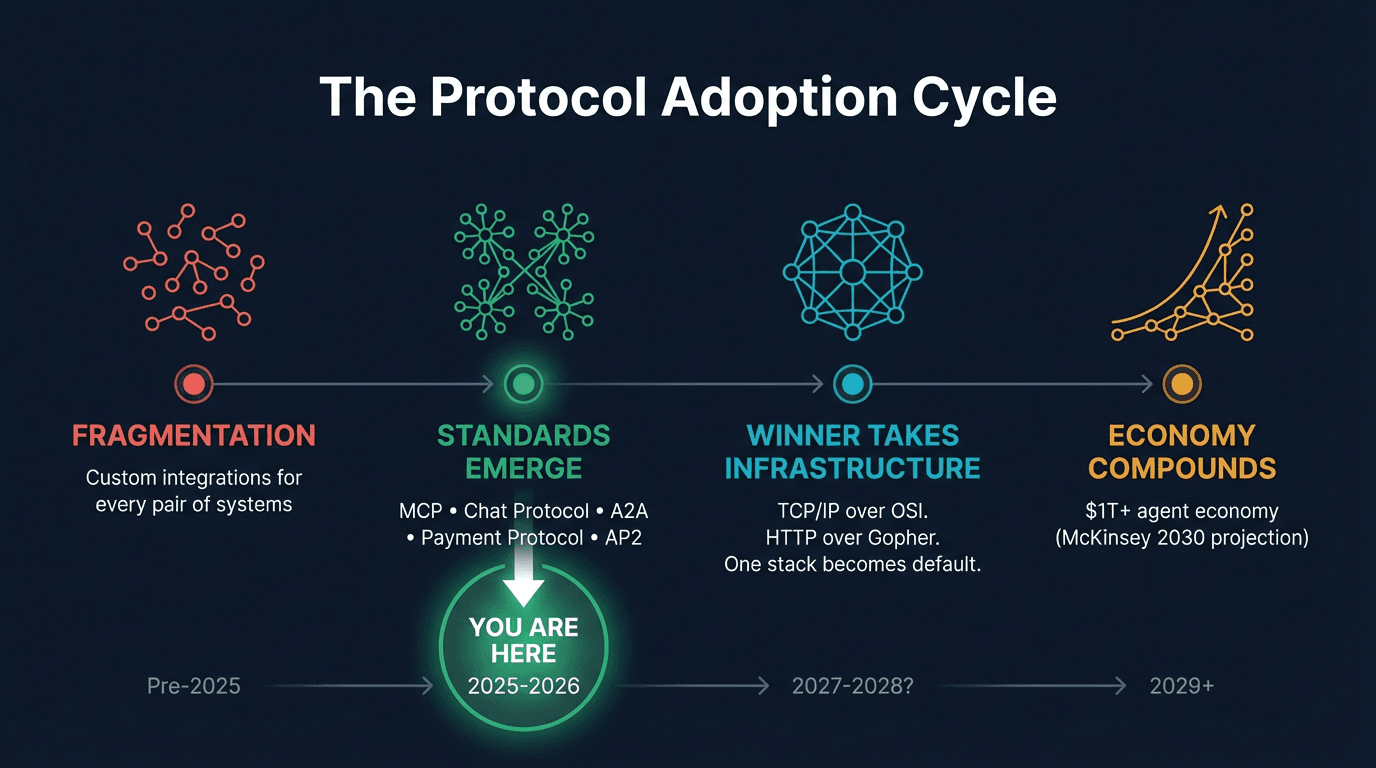
A critical lesson from TCP/IP's victory over OSI: the simpler, more pragmatic protocol won. OSI was technically more sophisticated - seven layers versus four, more granular abstractions, stronger theoretical foundations. TCP/IP won because it was simpler to implement, easier to adopt, and driven by practitioners instead of committees.
MCP and A2A are following the TCP/IP playbook: open-source, driven by implementors, backed by organizations that ship products. The AAIF governance model mirrors the IETF's "rough consensus and running code" philosophy. This is not a coincidence - the people building these protocols studied the history.
The Multi-Agent Future Is an Economic One
The most consequential implication of standardized agent protocols is economic. When agents can discover, authenticate, negotiate, and transact with each other across organizational boundaries, you do not get a better chatbot - you get an economy.
Consider what becomes possible when the protocol stack is mature:
Agent-to-Agent Commerce
Your personal AI discovers a travel agent via A2A Agent Cards, negotiates rates via Chat Protocol, and settles payment via the Payment Protocol - all without you opening a browser. The travel agent earns revenue from AI clients, not human ones. McKinsey projects the agentic commerce market will exceed $1 trillion by 2030.
Cross-Organization Coordination
Supply chain agents from different companies coordinate inventory, logistics, and pricing in real time - without humans on either side approving each transaction. Tyson Foods and Gordon Food Service are already doing this with A2A.
Autonomous Service Markets
Specialized agents advertise capabilities via Agent Cards, compete for tasks on quality and price, and earn revenue autonomously. A code review agent, an accessibility audit agent, and a security scanning agent compete for your CI/CD pipeline - and the best one wins the work.
As we wrote in Building AI Teams, teams of specialized agents outperform monolithic assistants. Standardized protocols turn that observation from an architectural pattern into an economic reality - agents can specialize, compete, and collaborate across organizational boundaries.
What to Do Now
You do not need to predict which specific protocol implementation will win every layer. You need to make decisions that position your team on the right side of the transition - and avoid the decisions that lock you into the wrong one.
Avoid
- Proprietary agent-to-agent communication
- Custom tool integration formats when MCP works
- Architectures that assume agents are standalone
- Skipping agent identity and authentication
- Vendor-locked agent frameworks with no interoperability
Invest In
- MCP servers for your product's tool capabilities
- Agent communication protocols (Chat Protocol, A2A) for peer collaboration
- Payment protocol support (Fetch.ai Payment Protocol, AP2) for agent commerce
- Agent Card definitions for capability advertisement
- Agent identity from day one
- Protocol-agnostic agent logic (separate business logic from transport)
The Cost of Waiting
In 1983, TCP/IP was a protocol decision. By 2003, it was the foundation of the global economy. The people who built on it early - who invested in HTTP, SMTP, and the protocols that ran on top - created the companies that defined the digital age.
MCP, Chat Protocol, A2A, Payment Protocol, AP2, and the AAIF are the TCP/IP moment for AI agents. The tool layer is mature. The communication layer is standardizing. The payment layer is bridging. The governance is consolidating. Build on the stack now - or spend the next decade catching up.
Build agents that participate in the network economy
Our team builds multi-agent systems on standardized protocols at Fetch.ai, ASI:One, and Flockx. If you're architecting agent systems and want to discuss protocol strategy, I'm happy to share what we've learned.